Yesterday, we brought Summer in to Children's for a CT scan with contrast to check whether or not fluid injected into the cyst will leak. The only appointment time available was one without anesthesia, which I was really apprehensive about since she had never before been awake during a CT scan.
Dr. Browd was scheduled to do the injection of the contrast, but was in an emergency procedure when we arrived, so a couple of resident doctors who have followed Summer's case came down to help us instead. They swabbed the area around her Ommaya reservoir with iodine, then inserted a needle and withdrew some of the fluid from the cyst, replacing it with the same amount of contrast solution. The contrast acts like a dye. It's a clear liquid, but is visible on the CT scan.
Summer wasn't happy about it, but who would be? I think she was mostly just upset that we were holding her head still and people were messing with her. She bled a tiny bit after they removed the needle, but all-in-all it was a pretty uneventful procedure. She'll have to go through the same process (except they'll inject Interferon rather than contrast) twelve more times over the next few weeks.
We had to wait for a little while for the contrast to disperse, and then they brought us in to the CT room. I had to lay Summer down on the table, with her head positioned between two padded tension paddles and held down by a padded strap to keep it still. Then they swaddled her body onto the table so she couldn't squirm around. They left one hand free so I could hold it during the scan, and gave me a flashing Mickey Mouse light to distract her with. Yeah, right!
She was NOT happy at all about being strapped down on the table while it slid back and forth through a big machine that made a loud whirring noise. Luckily, it was all over pretty quickly, and they got the scans they needed without having to do it again. I felt awful for her, but honestly she screams much more forcefully when she's getting her hair rinsed out in the bathtub at home...so it can't have been too bad. She calmed down as soon as we got her unstrapped from the table and I was holding her again.
The scans showed no leaks from the cyst, so we're set to start with the first Interferon injection tomorrow at 3pm. This one will be slightly different from the rest of the treatments because they'll withdraw as much of the fluid as they can from the cyst before injecting a small amount of the Interferon. Going forward, they'll only remove as much fluid as they will replace with Interferon so they can tell if the cyst is continuing to produce fluid on its own.
This week, Summer will have had four doctor's appointments in five days. Today was Summer's two-year checkup with our pediatrician, Dr. Anderson. We talked about a lot--vitamins, diet, development, etc.--but there's not really anything major to report. Summer weighs 22lbs 12oz (6th percentile) and is 33" long (35th percentile). She had to have one shot, and it was a breeze. I miss the days when I would agonize over taking her to the pediatrician for shots because it seemed like such a big deal...

Tuesday, September 14, 2010


Friday, September 10, 2010
Summer is 2 today!
Summer kicked off her second birthday with an early morning MRI. Here she's sleeping off the anesthesia.

We didn't really learn anything new from it. The cyst is still refilling, which is to be expected. The catheter is still in place, and everything looks okay for us to start Interferon next week.
We talked about the feedback from Boston, and Dr. Geyer said that the tumor board here had also discussed the proximity to the optic chiasm and didn't think there was impending danger at this point. With careful monitoring, we should catch any changes in time to get to radiation before that area is put in danger.
On Monday, we'll go back in to have her head shaved over the Ommaya reservoir site. They'll sterilize the area, apply some numbing cream and use a needle to pull a little bit of the cyst fluid that has accumulated through the Ommaya. Then they'll inject the same amount of dye back into the cyst. This test will make sure the catheter is functioning as it should and will work for the treatment. She'll then have a CT scan - awake - to confirm that the cyst isn't leaking.
I'm not sure how well the CT scan will go. She's never had one unless she was already under anesthesia. They said I can hold her throughout the procedure and that it's pretty quick, but Summer has a reputation for fighting pretty much anything the doctors and nurses want to do. They may have to give her some sort of sedative to help her calm down. We'll see.
Then the plan is to start treatment on Wednesday afternoon. They'll withdraw as much of the cyst fluid as possible through the Ommaya and then inject a small amount of the Interferon into it. That will be the first of 12 treatments, which she'll have every Monday, Wednesday and Friday.
Yesterday I googled 'intracystic Interferon' (for about the millionth time over the past few weeks) and my blog came up on the first page of Google results. Hard to believe that the treatment we're about to start is so uncommonly used that my blog is one of the best hits...
Most of the information out there about Interferon is for systemic use, which is a much larger dose given intravenously, and affecting the whole body. It does have more side effects, but compared to other drugs they're pretty minimal. When given in a very small dose directly into the cyst, the only side effects we might see are flu-like symptoms: fatigue, fever, weight loss, loss of appetite and behavioral changes. These side effects will go away once the treatment is done.
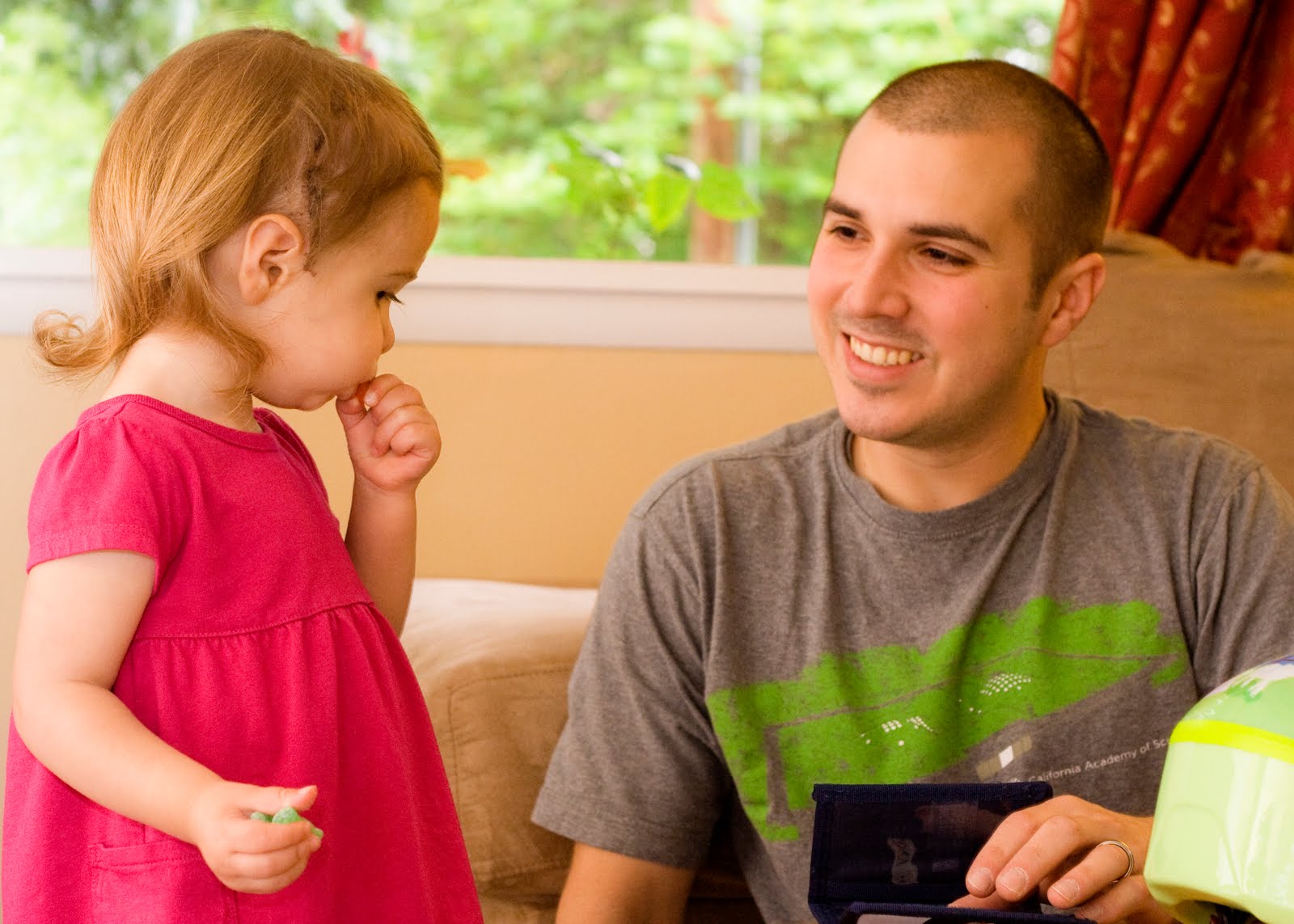
We got home from the hospital at about 10am this morning and kicked off the birthday festivities:
 |
| The gifts |

 |
| "CANDIES!!!" |


 |
| "Happy birthday Mommy!" |

 |
| It's a surprised bell! |
 |
| A walk to the store |
 |
| Testing out the trike |

 |
| She did not want to wear a helmet! |
 |
| Someone gave Summer this amazing hand-me-down gift. She was very excited! Can't wait to play with it more tonight. |
Summer's birthday card made it onto sproutonline.com, but sadly not on the Birthday Show. Next year I won't miss the deadline! They only scanned the front, but here it is:

It's been a fun day, despite a visit to the hospital, and there's more fun to come! Now, I'm off to frost a birthday cake!

It's been a fun day, despite a visit to the hospital, and there's more fun to come! Now, I'm off to frost a birthday cake!
Wednesday, September 8, 2010
A quick update
We heard back from Boston yesterday morning. I won't go in to great detail about what they said because it's mostly a repeat of things I've already explained. The overall verdict was that it's probably okay to try the Interferon and wait, with VERY close monitoring.
The proximity of the tumor mass to her optic chiasm (the part of the brain where the optic nerves cross) was enough to make them a bit nervous. Since the Interferon treatment won't treat the mass at all, the tumor mass will continue to grow. We have to be careful not to let it get too close to the optic chiasm where it could cause damage, or force us to include part of the optic chiasm in the field of radiation. Any damage done to that area would likely be irreversible, and the bit her vision has already suffered is enough!
They suggested staggering six-week checkups by a neuro-ophthalmologist with the six-week MRI schedule so we'd be checking in every three weeks, and would hopefully catch any significant changes early on.
We have an MRI on Friday morning (Summer's birthday!), followed by an appointment with Dr. Geyer. We'll be able to talk with him then about Boston's response (they've updated him as well) and confirm that we still want to move forward with the Interferon treatment.
I'll post again after that appointment.
Wednesday, September 1, 2010
Catching up
Sorry for the delay in posting. I’ve been busy doing a lot of research over the past two weeks, trying to reach a decision that we can be comfortable with.
Per my last post, we have been given a decision to make – try a chemotherapy option, called Intracystic Interferon treatment, or go directly to radiation. It’s an impossible decision, with no clear winner, but we’re forced to somehow choose.
Jason had always leaned toward the Interferon option, while I have had more reservations about it. After doing a lot of research, and talking to multiple doctors across the continent, I’m leaning toward Interferon too.
There just really isn’t much on it. I found two studies, completed in 2004 and 2007, with a grand total of 30 patients treated with Intracystic Interferon. It is a drug that is used frequently to treat other cancers, just not this one and in this manner.
I also found a comparison of Bleomycin (the drug initially suggested) and Interferon, which showed that Interferon did seem to have some advantages. Mainly, there were fewer side effects if the drug were to leak out of the cyst.
The studies that have been done appear to be promising. It doesn’t work for everyone, but when it does, it buys a median of just over a year until radiation becomes necessary. Of course, it’s a very small sample size, so it’s impossible to say how much time it will buy for us, if any.
I received one report back from the Craniopharyngioma support group about the use of this drug. Although it didn’t save their son’s life from a very aggressive form of the tumor (it metastasized after two bouts of radiation), it did shrink the cyst and provide him some relief from headaches during his last few months.
I spoke with Dr. Merchant at St Jude’s about the treatment, and he was under the impression that this course of treatment had been abandoned. He referred me to a doctor in Vancouver, B.C., who had actually written the comparison article I mentioned above. Her response was that it certainly does still have a place in treatment for Craniopharyngioma, but that it’s only appropriate in select cases. Summer’s case is one of them. Most people aren’t diagnosed this young, and the risks of going straight to radiation are lower, so it’s just not an appropriate treatment step for them.
After looking into it further, I started to feel more comfortable with the treatment itself, but just wasn’t sure I wanted to take the risk of allowing the tumor mass to continue to grow. What if the tumor spouts off another cyst and we’d have to go back for another surgery? What if the tumor causes pituitary problems that wouldn’t be a direct result of the radiation, like Diabetes Insipidis?
We decided to get a second opinion from Massachusetts General Hospital, one of the places we might end up for radiation at some point anyway, to make sure they felt comfortable holding off on proton therapy for a while, assuming the Interferon treatment works. I spent a week working with Children’s to collect all of her records and send them off to Boston. The nurse practitioner we work with on the HemeOnc team, Katie, was immensely helpful with this task, and we were able to get everything to them by yesterday afternoon, in time for the cutoff to review Summer’s case today. We should hear back from them today or tomorrow.
In the meantime, we also had a few appointments at Children’s. Last Wednesday, we had an Ophthalmology appointment to check her eyesight. We were happy to find out that her visual acuity (how well she sees when she’s looking directly at something) has actually improved since her last vision appointment after the first surgery. She’s well within the normal range for her age.
Just this morning we had another VEP test (the one with the electrodes), and Summer was very cooperative for it! It showed a bit more optic damage from the cyst growth, but you certainly wouldn’t know it from watching her. She doesn’t bump into things or seem to have trouble seeing things. We do know that her peripheral vision is still damaged, as she’ll often startle as if something just jumped out at her, when it had been there the whole time. Luckily, she’s so young that she won’t ever know anything different.
We won’t know how big her visual field is or what level of contrast she can see until she’s old enough to do some more extensive testing that would require her to verbalize what she’s seeing.
Last Friday, we had a wound check with neurosurgery (everything looks great, she’s healing well!) and an appointment with Dr. Geyer to talk more about the options. After speaking with him, and going over our concerns again, we have decided to move forward with the Interferon treatment as long as Mass. General agrees that we can hold off on proton therapy for a while longer. We’ll probably start treatment in the next week or two, and we’ll monitor with MRIs every six weeks. The first will be at the end of September.
Dr. Geyer reiterated that he thinks either choice will be the right one. It’s simply a matter of weighing the risks and figuring out which ones we’re comfortable taking. Choosing to go with Interferon means that we’re willing to risk another surgery in order to give Summer’s cognitive functions a little more time to develop before radiation.
Even if we went to radiation right away – and that’s still a possibility if the Interferon doesn’t work – she would still be a pretty normal kid. She just may have a little more difficulty with some subjects in school than she would have without radiation. We would never know for sure. But, we do know that we want her to have the best chance in life possible. If that means another torturous couple of weeks from another surgery, we think it would be worth it in the long run to know that we did everything we could.
Saturday, August 21, 2010
Our hospital stay
I took some photos during our hospital stay in case Summer is ever curious about what she looked like after brain surgery. I didn't intend to post any online, but a few were too sweet not to share.


Friday, August 20, 2010
FAQs and more info
We're home now and adjusting back to normal life. Summer was not as thrilled as we'd expected when we first got home last night. I think she was disoriented from being woken up, too close to needing more pain meds, and wanting to stay outside. But after some oxycodone and time to adjust, she was running around the living room like nothing had happened.
Today we've had a couple of visitors, and even took a walk to the park where Summer went on the swings. She had a rough morning, but was very happy as soon as we got outside.
Here I'll address some of the questions I get most frequently about treatment and this second surgery:
Q: Since the doctors already think she'll need proton therapy, why did Summer have to have another craniotomy? Why not just do the radiation instead?
A: Summer's tumor is part solid mass and part cyst. In the last three and a half months since her first surgery, the cyst grew very rapidly and was quite large. It can only be reduced surgically.
Radiation is effective in treating the mass portion of the tumor, and preventing it from producing more cysts, but it won't fix any cysts that already exist. Although the cyst didn't appear to be causing any problems for her now, it needed to be addressed surgically to prevent future problems and shrink the field of radiation that will eventually be necessary to stop the tumor from growing and refilling the cyst.
Q: Why not just remove the whole tumor? It's benign, right?
A: Yes, Summer's tumor is benign but it's considered malignant by location, since there isn't really any room to spare in the brain. It's also sticky, and very difficult to remove without damaging important structures, like the optic nerves, pituitary gland and hypothalamus.
Our doctors recommend a very conservative approach to tumor removal since radiation typically has a very high success rate for craniopharyngioma. So far, she has no pituitary damage, and we hope to minimize that damage by leaving it alone. Surgical removal of the tumor frequently causes more pituitary problems than radiation, and is more likely to affect production of some of the hormones that are most difficult to replace effectively.
Q: So what's next?
A: Jason and I have some big decisions to make in the next week. We have an appointment with the oncologist on Friday to discuss whether we'd like to move forward with the chemotherapy option, or just skip straight to radiation.
As of right now, we're leaning toward chemotherapy. There's no guarantee it will work, but the doctor doesn't think we lose anything by trying (side effects are very minor) and we might gain more time until radiation becomes necessary for Summer.
The only real downsides are: 1) it might not work, 2) it means more wait-and-seeing, and 3) it won't treat the tumor mass, so that will continue to grow (and could potentially put off more cysts).
On the plus side 1) it might work and buy time; 2) it could mean Summer experiences fewer side effects from radiation if we are able to wait, although we'll never ever know if this is true or not, and 3) the mass may grow slowly enough that it won't cause problems or increase the eventual field of radiation too much.
It's all a lot of hypothetical and we'll-never-know-for-sure stuff to deal with. Frankly, it's more than my brain can handle right now. Up until Wednesday, we thought proton therapy was the guaranteed next step and chemotherapy was never even on our radar. I honestly was a little bit relieved to give up the wait-and-see approach and DO something about this darn tumor.
We haven't yet had a good scan with Summer, which doesn't make the prospect of more waiting-and-seeing any easier for me. We did bring that concern up with the oncologist and he agreed that scans every six weeks would be beneficial, at least in the beginning, since her tumor has proven it works quickly. He also said that if it becomes apparent the treatment is not working, we can stop at any time and skip to radiation. That flexibility is good.
I have a lot more research to do before I'll be comfortable committing to the chemo option. It would be injections of Interferon, not Bleomycin as I had stated before, so I want to look into the difference. There's not a lot out there on this particular treatment used for Craniopharyngioma because most kids are old enough to just go straight to radiation and don't need to buy time. I'll dig up some studies, solicit feedback from the Craniopharyngioma support group I belong to, and also get a second opinion from Dr. Merchant at St Jude's if possible. I already have come up with more questions for Dr. Geyer (the oncologist here at Children's) since we met with him yesterday.
Now, I'm off to go on another walk with Summer!
Thursday, August 19, 2010
Potential new treatment option
We had a relatively eventful day yesterday, with some potentially exciting news from the doctors about a possible treatment route for Summer that would allow us to avoid radiation for a while longer.
They discussed Summer's case and reviewed her post-op scans at the tumor board meeting yesterday, and everyone was very happy with the "drastic" reduction in size of the cyst and Dr. Browd's placement of the catheter.
We met with Dr. Browd and Dr. Douglas (the radiation oncologist here) after the tumor board meeting. Dr. Douglas explained our radiation options in a little more detail.
We learned that Summer's tumor is uniquely positioned in front of her pituitary, rather than above it where most craniopharyngiomas are located. Dr. Douglas was quite surprised that she isn't showing any sign of pituitary damage so far.
We talked about conformal radiation therapy (also called standard, or IMRT), which isn't really an option in my mind because it radiates more normal tissue than proton therapy, the route we were told to start planning for now.
We also talked about something called Gamma Knife, which can be done here. It is a radiation treatment that lasts 1-5 days, with 195 beams aimed at the tumor. It's not available to children under three, but is an option we should consider if we can delay radiation a bit longer.
Just the reduction of the cyst doesn't buy us a lot of extra time. The cyst has proven that it will continually refill, and it will be quick about it. The problem with just continually draining the cyst as a way to control things for a while is that the cyst may not fill uniformly. It could section off (as it appears to already have done once) and start filling in a portion that is not reached by the catheter.
Moving directly to proton radiation should keep the cyst from continually refilling. But, it isn't ideal to do it at such a young age. Her vision shouldn't be affected by proton therapy because the reduction of the cyst has pulled it away from the optic nerves, so the field of radiation wouldn't need to include that critical structure. Also, the major language and motor control centers are far enough away that they will not be affected. Proton therapy has the ability to aim the beams to avoid these areas.
What it can affect, and likely will to some extent, is her cognitive reasoning, short-term memory and pituitary function. There are some essentially guaranteed losses from radiation - growth hormone production being one of 5 or so hormones that she is quite likely to lose the ability to produce. All of them can be replaced. Some of the more difficult hormones to control, like the one that regulates urine output, is pretty unlikely to be affected, so that bodes well for Summer's quality of life going forward.
Dr. Douglas and Dr. Browd both touched on a new treatment option that came up in tumor board. I'll give an overview of it here, but we still have a lot of questions to ask Dr. Geyer about it too.
There is a treatment called Intracystic Bleomycin therapy (ICB), which is essentially localized chemotherapy, and that they think may help us buy time for radiation. Chemotherapy is generally not effective in treating this particular type of brain tumor. In fact, even ICB wouldn't really do any damage to the tumor mass itself, but it could help control the cyst and keep it from re-filling.
They would inject Bleomycin directly into the cyst through the Ommaya reservoir and catheter they implanted on Monday. The when/frequency/dosage sort of details are all still questions I have. This should kill the tumor cells that line the cyst walls and produce the motor oil-like fluid that the tumor produces to fill the cyst.
I did some initial research online, and found that it seems to be a relatively successful treatment, with very few side effects. They would first need to test for leaks from the cyst by injecting contrast into the cyst and then performing a CT scan to check for leaks. If there are leaks present, the side-effects are much more concerning. If there aren't, the only side effect reported seems to be possible headaches at the time of injection.
Like I said, we still have TONS of questions for Dr. Geyer and I want to have him confirm the things I found online. But, this definitely sounds like something to consider.
If it doesn't work, we would just go on to radiation anyway. If it does, we have bought some time. I'm also curious to know how much time Dr. Geyer thinks it could realistically buy, given the growth in the tumor mass so far. Studies done report an average somewhere around two years. Even six months could be a compelling reason to try it.
I'll post more when I know more. We're hoping to see Dr. Geyer today, before we GO HOME! Summer has been like a broken record with that request the past couple of days. I certainly can't blame her!
Subscribe to:
Posts (Atom)